Our region is many places, connected by a shared future.
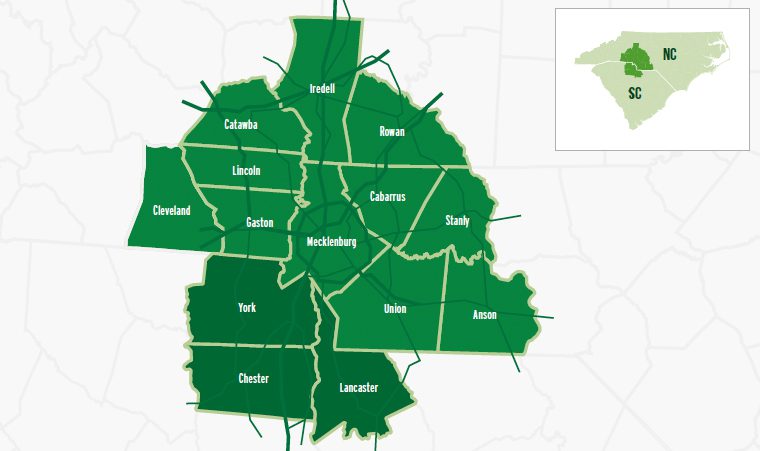
The Charlotte region is a collection of communities, landscapes and stories stretching across 14 counties in North and South Carolina. From growing urban centers and historic downtowns to farms, forests, small towns and rural communities.
Each place has its own character. Together, they form a region that is deeply connected — by roads and rivers, schools and workplaces, businesses and institutions, families and friendships, and the everyday choices people make about where t o live, work, learn and spend their time.
A region in motion
This is a place shaped by change.
Over generations, the region has grown from a network of Indigenous trading paths, farms and small communities into one of the nation’s fastest-growing metropolitan areas. Rivers that once powered mills helped build an industrial economy. Today, a growing skyline, new businesses, neighborhoods and cultural institutions reflect a region that continues to evolve.
But the story of growth looks different from place to place.
Beyond the urban core, farms and forests remain an important part of the landscape and economy. Historic downtowns and small towns are adapting to new opportunities and challenges. Suburban communities continue to grow and change. And Charlotte itself has become a major economic and cultural center with connections that reach well beyond Mecklenburg County.
The result is a region that is both urban and rural, established and emerging, connected and distinct.
What connects us?
The boundaries between counties may be drawn on a map, but the forces shaping our communities rarely stop at those lines.
People cross county and state borders every day for work, school, health care, recreation and family. Water flows across jurisdictions. Transportation networks connect communities. Businesses draw workers from across the region. Decisions about growth, housing, land use and the environment in one community can have consequences far beyond it.
Our region’s greatest opportunities — and some of its greatest challenges — are shared.
That makes it important to understand not only what is happening in individual communities, but how those communities fit together.
Understanding where we are — and where we’re going
The Charlotte Urban Institute studies this region because understanding where we are is essential to shaping where we go next.
We look at the forces changing our communities and the experiences of the people who live here. We examine questions of economic opportunity, housing, transportation, education, health, the environment and quality of life. And we look for the differences within and across our counties — because regional growth does not affect every person or place in the same way.
We ask: Where are people and communities thriving? Where are there gaps in opportunity or investment? What can we learn from the places finding innovative ways to adapt? How can we grow while protecting the people, places and natural resources that make this region distinctive?
There is no single story of the Charlotte region. There are many.
And understanding those stories — how they differ, where they intersect and what they tell us about our shared future — is essential to building a stronger region for everyone who calls it home.
Explore the region
From Anson to York, each of our 14 counties brings something different to the story of this region. Explore the communities below that make up the Charlotte region and discover the people, places, history and trends that help define them.