Two steps forward, one step back
Charlotte’s uneven road to 2030 and beyond
2025 was Charlotte’s most consequential moment for transportation.
With support from local leaders, state legislators passed the Projects for Advancing Vehicle-Infrastructure Enhancements Act, or P.A.V.E Act, giving Mecklenburg County – and neighboring counties – the ability to ask voters whether they wanted more tools to fund transit. Shortly after, voters in Mecklenburg County approved a long-awaited transit referendum, signaling public support for expanding transportation options beyond driving alone. Collectively, these decisions suggested a shift in how those in Charlotte expect transportation to work.
Public attention soon followed. The focus? Buses, rail and novel approaches to our long-term transportation needs. The conversation? Loud, emotional and long overdue.
But while most eyes were on transit, another major transportation initiative moved forward under our noses.
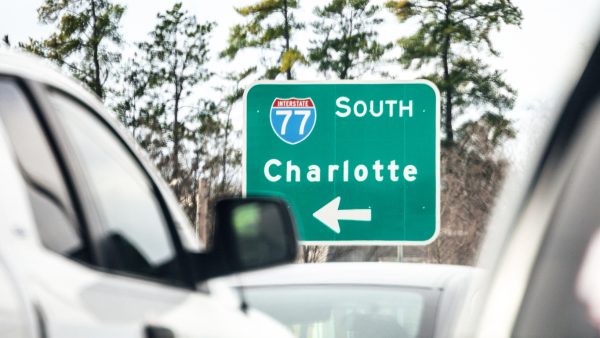
During the height of the referendum debate, the North Carolina Department of Transportation announced plans to expand Interstate 77 South with new express toll lanes. With public attention on the transit referendum, the I-77 South announcement effectively evaded public scrutiny, with many residents, even those of us who stay closely engaged, surprised to learn just how far along the project plans were.
This move raised a question: are we changing how we move, or are we trying to repeat a play from history while no one is paying attention?
The proposal
That question sits at the center of the I-77 South Express Lanes debate. A question now asked as the corridor between Uptown Charlotte and the South Carolina border continues to struggle under the weight of growth, car dependence and limited alternatives. For commuters, congestion is a daily pain point. For state planners, it’s a familiar focus.
The I-77 South project would rebuild and widen approximately 11 miles of the interstate between Uptown and the South Carolina state line. It would add managed toll lanes, rebuild bridges and interchanges and expand the highway’s footprint. NCDOT says the project will reduce congestion, improve safety and provide more reliable travel times along one of the region’s busiest corridors.
The argument for the project is familiar: traffic keeps growing and commutes are unreliable. The region depends on I-77 for daily travel and freight. Supporters say express lanes give drivers options. They can pay a toll and move faster, or use the general lanes for free. Toll revenue, they argue, allows the state to move forward quicker than traditional funding allows.
For drivers stuck daily in traffic, that logic is easy to understand. It also reflects how we’ve made transportation decisions for decades. When roads fill up, we widen them.
Who it impacts
For many who live near I-77, this project is not just about traffic. It’s about history, connection and overall well-being.
The interstate already cuts through some of Charlotte’s historically Black neighborhoods, including Biddleville and McCrorey Heights. Those earlier highway projects (read“Repairing the Mistake of I-277”), displaced families and tore communities apart. Those impacts did not end when construction finished. They shaped housing patterns, health outcomes and neighborhood investment in ways that are still visible today, for better or for worse.
And the most dramatic proposal on the table would deepen those harms considerably.
The expansion would cut further into already historically impacted neighborhoods and reach into places like Wilmore, where entire streets of homes would disappear. It would also erase Frazier Park, a long-standing public amenity that serves nearby communities. For residents, this is a significant loss. It means the disappearance of green space, shared memories and one of the few buffers separating homes from the interstate. Even without large-scale displacement, a wider highway would bring more noise, more pollution and more formidable physical barriers between neighborhoods.
Community members have also raised concerns about nearby historic and cultural sites, including Pinewood Cemetery, a burial ground for many of Charlotte’s Black residents during segregation, while white residents were buried at Elmwood. This marks the second time a highway project has threatened the site. I can’t help but question whether the project fully accounts for what could be lost, not just in land, but in history and cultural relevance.
Local neighborhood groups and nonprofits have gone so far as to create an area coalition and authored a letter calling on the state to pause the project and reconsider its approach. They point to a long record of highway expansions that delivered short-term relief at best, only to see congestion return while communities absorbed the costs.
While many of these scenarios apply primarily to the “worst-case” plan, their inclusion implicitly frames the debate as the choice between acceptance and consequence: approve the double-decked options, or risk far more destructive outcomes.
Why congestion returns
Beyond neighborhood impact, critics question whether expanding I-77 fits the moment. Just months earlier, voters supported a transit plan meant to reduce reliance on driving. The goal was not only to move people faster, but to give them real alternatives to highways.
Charlotte has already tested the highway-expansion approach on this very corridor.
I-77 North was widened and outfitted with express toll lanes with the promise of easing congestion. Years later, daily conditions tell a different story. Traffic through Huntersville and north Mecklenburg remains a constant challenge with congestion still defining peak hours. The expansion did not deliver lasting relief for most drivers.
The toll lanes themselves highlight the limits of this approach. Many drivers avoid them because of cost. Others use them sparingly. For regular commuters, the price adds up quickly. Drivers travelling the full length from Mooresville to Uptown can end up spending hundreds a month ($28.85 a way to go about 23 miles per WSOC) For many households, that is simply not sustainable.
This is not an abstract concern. My wife drives this stretch of I-77 every day. Even as a reverse commuter, she still questions the value of the widening. The road is wider, but the experience is largely the same. Congestion remains, and the toll lanes see limited use from anyone unwilling or unable to shoulder the cost.
This outcome should not surprise anyone.
Highway expansion often works against its stated goal. When new lanes open, more people drive. Traffic returns. This pattern is well documented. Adding capacity rarely fixes congestion for long.
This idea is not new. Economist Anthony Downs warned as early as the 1960s that expanding highways would fail to solve congestion. What became known as Downs’ Law of Peak-Hour Traffic Congestion explains why. When road capacity increases, more people choose to drive at peak times. Over time, traffic grows to fill the new space. The result is familiar: wider roads, similar congestion.
The experience on I-77 North offers a clear preview of what expanding I-77 South is likely to deliver: high cost, uneven benefit and congestion that never fully goes away.
What it costs
Cost also matters, especially at this scale.
The I-77 South Express Lanes project is expected to cost several billion dollars. That makes it one of the largest transportation investments in the region’s history. Once that level of funding is committed, it shapes what the state and region can afford to do next. Money spent widening highways is money not spent elsewhere. That tradeoff deserves more public discussion than it has received.
Transportation funding is limited. Hard choices remain. Every major project competes with transit service, road maintenance, safety improvements and neighborhood connections. A billion-dollar decision is not just technical. It reflects priorities.
There is also the question of who benefits most. Express toll lanes offer speed to those who can afford to pay. For some drivers, that reliability is worth the cost. For others, it is not an option at all. When highway expansions rely on tolls, they can widen the gap between people who have choices and people who do not. That reality should be part of the conversation.
What this moment demands
Charlotte’s growth adds urgency to this moment. The city is becoming denser, with more people living closer to Uptown than ever before. Travel patterns are changing as well. More residents want to walk, bike, or use transit for at least part of their daily trips. I hear it every day through my social media channels: people want the option to choose transit, and they are frustrated by the lack of safe, convenient and reliable alternatives. With 81 traffic-related deaths last year (2024) alone, it’s hard to blame them. Many people would rather read a book on a train than be responsible for piloting a two-ton vehicle through a sea of other two-ton vehicles. These trends do not eliminate the need for highways, but they do challenge the assumption that widening them should always come first.
Other cities across the nation are facing similar choices. Some have slowed or stopped highway expansions, some have removed highways altogether, and others have invested heavily in transit and local street networks. These shifts are not ideological. They are responses to cost, land limits and long-term outcomes.
NCDOT points to process in response to criticism. Officials note that environmental reviews are underway and public meetings are being held. They argue that express lanes can exist alongside transit investment and that the project meets a real need.
Process matters. But it does not answer the larger concern.
The issue is not whether I-77 needs attention. It does. The issue is whether expanding it aligns with the future Charlotte just voted for. The P.A.V.E. Act and the transit referendum were framed as turning points. They suggested a move away from a single-minded focus on highways.
Advancing a major interstate expansion at the same time sends mixed signals.
Transportation projects shape cities for generations. The highways built decades ago still shape Charlotte today. Decisions made now will do the same. This moment calls for clarity.
If transit, fair access to the city, and neighborhood repair matter, those values should guide every major transportation decision – not just the popular ones. That means asking hard questions, weighing real alternatives and being honest about tradeoffs.
The debate over I-77 South is not just about toll lanes. It is about whether Charlotte will use this moment to change direction, or whether the past will quietly shape the future once again.
Disclaimer: The opinions of guest columnists are their own and do not reflect the position of the Charlotte Urban Institute.