Affordable housing in Charlotte: Why long-term investment matters

Housing affordability has become one of the defining challenges facing cities across the United States, and Charlotte is no exception. As housing prices continue to rise faster than wages, more residents across the income spectrum are struggling to find stable, affordable places to live.
This is the first article from a series of briefs that will help provide a clearer understanding of how Charlotte’s affordable housing investments shape housing stability, neighborhood conditions and economic opportunity across the city.
The cost of housing
A decade ago, more than one-third of homes sold in Charlotte cost less than $150,000. Today, fewer than two percent of homes fall within that price range. By 2025, the median home price in Charlotte had climbed to nearly $444,000, requiring a household income of more than $146,000 to afford a typical home — almost double Mecklenburg County’s median household income.
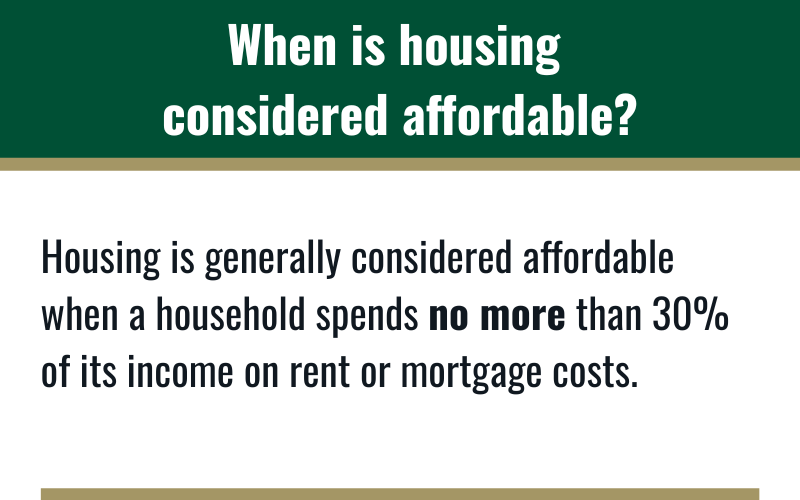
The pressure is particularly severe for the region’s lowest-income residents. In 2024, only 20% of extremely low-income households (defined as making less than 30% of Area Median Income, or AMI) in Mecklenburg County were able to access affordable housing. Housing is generally considered affordable when a household spends no more than 30% of its income on rent or mortgage costs.
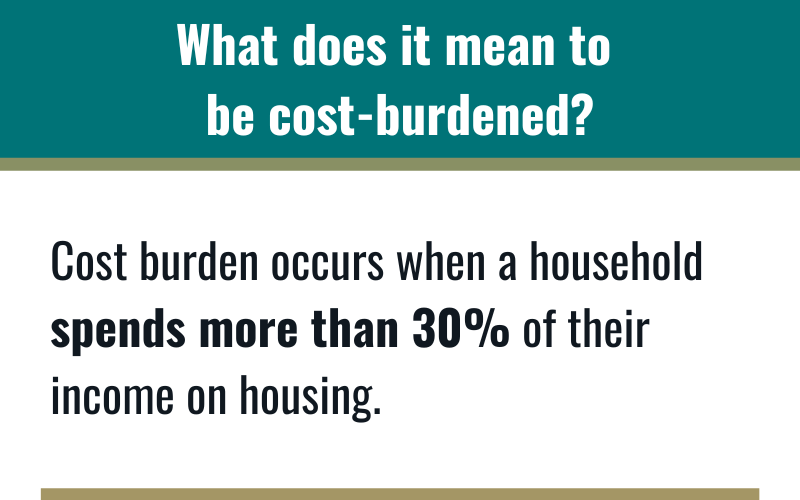
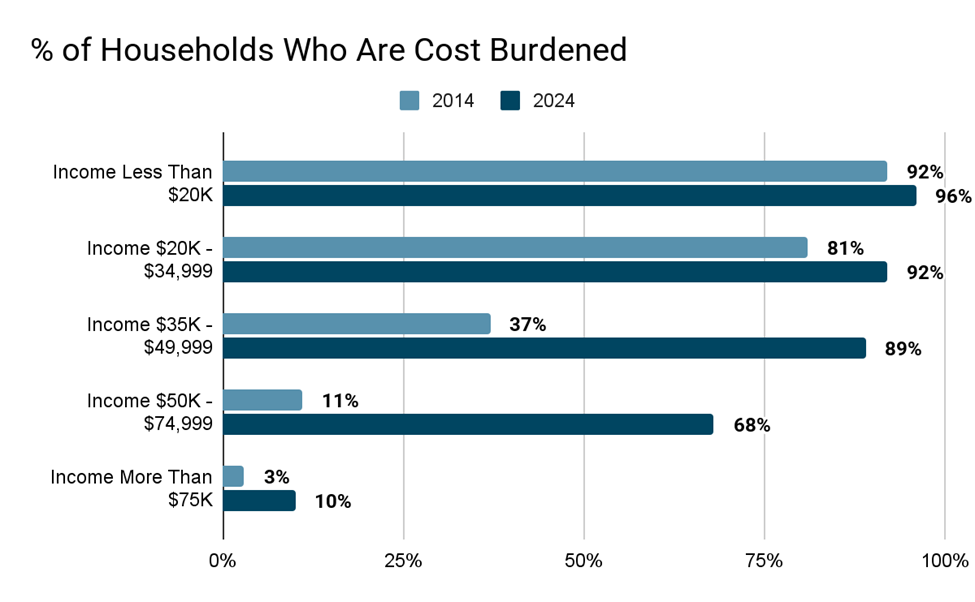
As affordable housing options become harder to find, more residents are becoming cost burdened, meaning they spend more than 30% of their income on housing. Today, about half of all renters in Mecklenburg County fall into that category. The figure below shows household cost burden broken down by income. In 2024, 96% of households earning less than $20,000 per year qualified as cost burdened, while only 10% of households earning more than $75,000 fell into this category. However, cost burden grew significantly from 2014 across the income spectrum.
The consequences extend far beyond monthly budgets. Research has linked housing cost burden to poorer health outcomes, increased risk of homelessness, reduced consumer spending and broader labor market challenges. While lower-income households are most affected, rising housing costs increasingly impact middle-income families as well.
A growing gap between housing costs and wages
Charlotte’s housing affordability crisis reflects broader national trends, but local conditions have intensified the challenge. Although housing construction has increased in recent years, the private market alone has not been able to produce enough affordable housing to meet demand.
Today, it costs an estimated $315,000 to build a single housing unit in Charlotte. Without public subsidies or financial assistance, developers often do not deem it profitable to build housing that is affordable to lower- and moderate-income households while still covering construction and financing costs.
At the same time, wages have not kept pace with housing prices. Historically, homes in the United States cost roughly three times the annual median household income. By 2022, that ratio had reached nearly six times the median household income nationally and remains historically high today.
The result is a widening affordability gap that affects both renters and homeowners.
Historical policies continue to shape housing outcomes
Charlotte’s current housing landscape did not emerge overnight. It was shaped by decades of federal, state and local policy decisions that determined who could own property, where housing could be built, and who had access to credit and investment.
Policies such as discriminatory mortgage lending practices, restrictive deed covenants, urban renewal projects, and predatory subprime lending disproportionately harmed Black and other communities of color. These practices limited homeownership opportunities, disrupted neighborhoods and constrained opportunities for intergenerational wealth building.
The impacts remain visible today. In Mecklenburg County, white households own homes at significantly higher rates than Black households. Black residents are also disproportionately represented among people experiencing homelessness.
These disparities underscore how housing affordability intersects with broader questions of economic mobility, wealth creation and community stability.
The role of Charlotte’s Housing Trust Fund
Recognizing the growing need for affordable housing, the City of Charlotte established the Housing Trust Fund, or HTF, in 2001. The HTF serves as the city’s primary public funding source for creating and preserving affordable housing. It is a key local resource for long-term investment in housing affordability.
The program provides gap financing to developers that helps bridge the difference between development costs and the rents or home prices that lower-income households can afford. In practice, this allows for the construction of affordable housing that would otherwise be financially infeasible.
Over the past two decades, Charlotte’s Housing Trust Fund has contributed more than $231 million toward the creation and preservation of more than 11,000 affordable housing units.
Much of the funding supports multifamily rental developments that use federal Low-Income Housing Tax Credits, or LIHTC, the federal government’s primary tool for financing affordable rental housing. In exchange for receiving tax credits, developers agree to keep units affordable for income-qualified households for at least 30 years.
Charlotte voters have repeatedly supported expanding the Housing Trust Fund through bond referendums, approving $50 million housing bonds in both 2020 and 2022, followed by a $100 million bond in 2024.
Affordable housing as long-term infrastructure
Affordable housing is often discussed as an urgent crisis, but the conditions driving the shortage are structural. The persistent mismatch between wages and housing costs cannot be resolved through short-term interventions alone.
For that reason, affordable housing investments are increasingly viewed as critical community infrastructure, essential to supporting economic growth, workforce stability and community well-being.
As Charlotte continues to grow, ensuring that teachers, healthcare workers, service employees, first responders and other essential workers can afford to live in the communities they serve will remain a central challenge.
Understanding the impact of the Housing Trust Fund
Given the scale of Charlotte’s housing challenges and the significant public investment involved, understanding the long-term impact of the Housing Trust Fund is critical.
As such, the Charlotte Urban Institute, in partnership with faculty from the Belk College of Business and College of Humanities, Earth and Social Sciences and community experts, was asked by the City of Charlotte to examine several dimensions of the HTF’s role in Charlotte, including:
• What tenant data is available for Housing Trust Fund-supported properties and how it can be used to better understand resident outcomes
• Existing research on outcomes for residents living in LIHTC-supported affordable housing developments.
• The impact of HTF-financed properties on neighborhood stability.
• Access to public transit for residents living in Housing Trust Fund-supported developments.
• Supportive services available to affordable housing residents, including employment assistance, financial coaching, and health-related programs.
• Outcomes associated with affordable homeownership programs supported by the Housing Trust Fund.
Don’t miss the next article in this series. You can keep up with the Charlotte Urban Institute’s analysis of Charlotte’s affordable housing by visiting the Institute’s website at ui.charlotte.edu or signing up for our monthly newsletter here.
Note: This article is a summary of a longer research brief written by Liz Morrell and was edited with assistance from Google Gemini.
References
Blumenthal, Pamela, Ethan Handelman, and Alexandra Tilsley. How Affordable Housing Gets Built. Urban Institute, 2016.
Charlotte Urban Institute. Home Ownership and the Legacy of Redlining: Charlotte’s Racial Wealth Gap. 2020.
City of Charlotte. Comment Letter on 2026 NC Housing Finance Agency Qualified Allocation Plan. 2025.
DeSilver, Drew. For Most U.S. Workers, Real Wages Have Barely Budged in Decades. Pew Research Center, 2018.
Federal Reserve Bank of St. Louis. When Houses Outrun Paychecks: The Lost Decades of Housing Affordability. 2026.
Fullilove, Mindy Thompson, and Rodrick Wallace. “Serial Forced Displacement in American Cities, 1916–2010.” Journal of Urban Health, vol. 88, no. 3, 2011, pp. 381–389.
Greater Charlotte Apartment Association. CLT Voters Approve Bonds & More. 2024.
Hanchett, Tom. Affordable Housing in Charlotte: What One City’s History Tells Us About America’s Pressing Problem. University of North Carolina Press, 2025.
Hanchett, Tom. Sorting Out the New South City: Race, Class, and Urban Development in Charlotte, 1875–1975. University of North Carolina Press, 1998.
Harvard University Joint Center for Housing Studies. America’s Rental Housing 2024.
Harvard University Joint Center for Housing Studies. The Rent Eats More: Residual Income Housing Cost Burdens from 2019–2023. 2025.
Hermann, Alexander, and Peyton Whitney. Home Price-to-Income Ratio Reaches Record High. Harvard University Joint Center for Housing Studies, 2024.
Mecklenburg County. Out of Reach 2025: What the Data Means for Charlotte-Mecklenburg. 2025.
Mecklenburg County Community Support Services. State of Housing Instability & Homelessness Report. 2026.
National Association of Realtors. Snapshot of Race and Home Buying in America. 2023.
National Low Income Housing Coalition. Charlotte Housing Trust Fund.
National Low Income Housing Coalition. Out of Reach: The High Cost of Housing. 2025.
National Low Income Housing Coalition. Overview of Housing Trust Funds.
National Low Income Housing Coalition. Why We Care. 2026.
Robert Wood Johnson Foundation. County Health Rankings Show Burden of Severe Housing Cost Tied to Poor Health. 2019.
Rose, Julie. “Hidden in Old Home Deeds, a Segregationist Past.” NPR, 2010.
Rothstein, Richard. The Color of Law: A Forgotten History of How Our Government Segregated America. Liveright, 2017.
Thomas, L., S. Idzikowski, A. Gaines, and J. Lane. The Racial Wealth Gap Charlotte-Mecklenburg. UNC Charlotte Urban Institute, 2019.
U.S. Census Bureau. American Community Survey. 2023.
WCNC Charlotte. “$50M Housing Bond Back on the Ballot to Tackle Charlotte’s Population Boom.” 2022.
WFAE. Charlotte Refines Affordable Housing Bond Plans. 2024.
WSOC. “‘Tremendous Victory’: Charlotte Voters Support Affordable Housing, Road Improvements.” 2020.