Over the past decade, we linked data on homelessness. Here’s what we learned.

By Sydney Idzikowski and Austin Trujillo
The Charlotte Regional Data Trust brings together data that typically exist in silos to inform effective decision-making and better understand the complicated issues our communities face. Over the past ten years, the Charlotte Urban Institute and Mecklenburg County Community Support Services have worked together to advance data-driven efforts to address housing instability and homelessness.
This article dives deeper into what we’ve learned through linking data about people experiencing homelessness to better understand how people are served across systems. This partnership represents the primary use of the Data Trust – to provide actionable data insights to address and highlight emerging and urgent issues in the field of homelessness services and prevention.
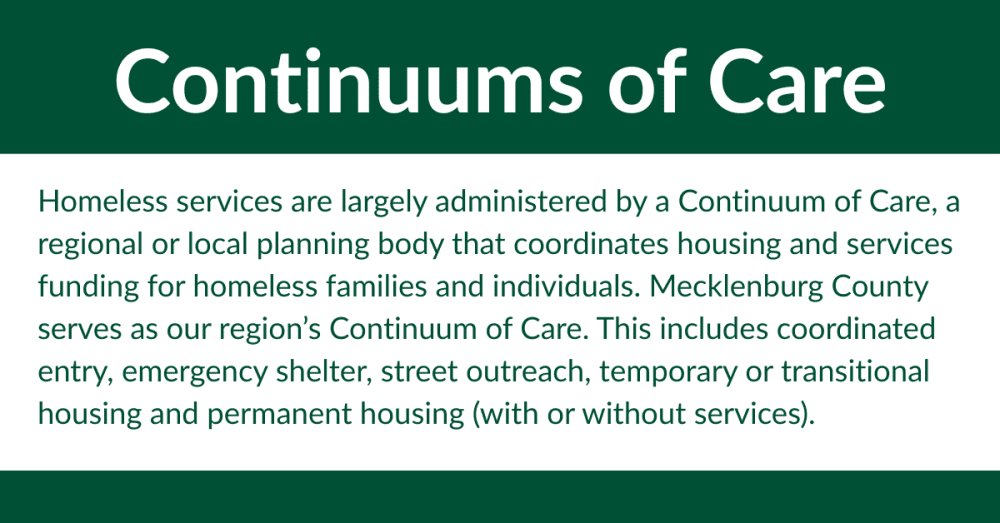
Continuums of Care use a Homeless Management Information System, a federally mandated local information technology database managed by Mecklenburg County Community Support Services. HMIS contains client-level and service-level data from over thirty local organizations regarding the provision of shelter, housing and services to individuals and families experiencing housing instability and homelessness.
At the Data Trust, we regularly link HMIS to other data we hold. Since 2015, the Mecklenburg County and Institute partnership completed seven projects using linked data about homelessness. These reports can all be found on the Charlotte-Mecklenburg Housing & Homelessness website. We explored different populations and trends related to:
- Families with children
- Data on children staying at an emergency shelter were linked to school records.
- Veterans
- Data on people who received housing or homelessness services were linked to data on those who received veterans services.
- Single adults
- Data on single adults who used housing or homelessness services were linked to data on other community services such as Food and Nutrition Services and the Crisis Assistance Ministry.
- Homeless prevention
- Data on people who received emergency rental assistance from the Crisis Assistance Ministry were linked with data on housing or homelessness services.
- Criminal justice history
- Data on people who were booked into a Mecklenburg County jail were linked with data on housing or homelessness services.
- Youth aging out of foster care and youth with a voluntary placement agreement
- Data on youth who were in foster care and/or with a voluntary placement agreement were linked with data on housing or homelessness services, bookings into a Mecklenburg County jail, and Food and Nutrition Services
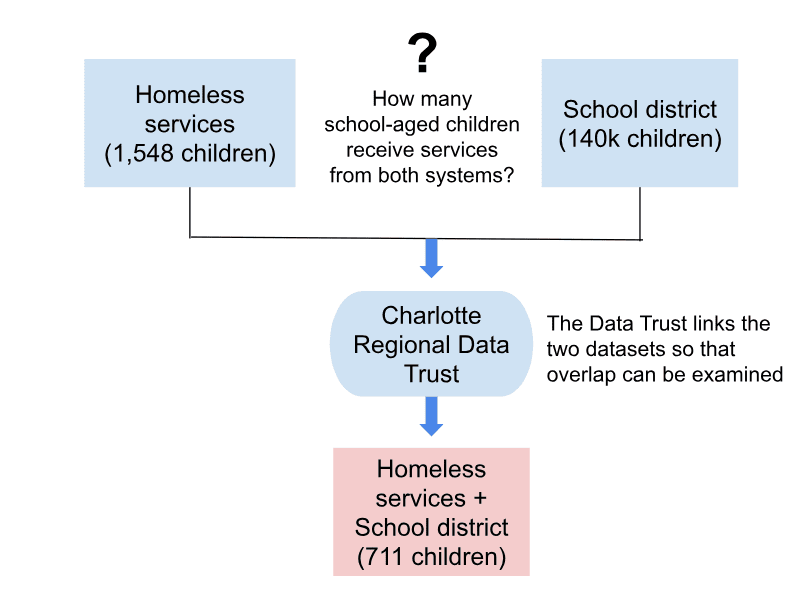
How data are linked depends on the study population and the research question. The figure below provides a visual example from the study about families with children.
What we learned:
- If someone has been homeless before, they are at a greater risk of experiencing homelessness again, especially when faced with a crisis or major life event or disturbance
- Individuals who experienced sheltered homelessness in an emergency shelter or transitional housing in the two years prior to applying for emergency rental assistance were 12.4 times more likely to experience subsequent sheltered homelessness than individuals who had not. Black or African American individuals were 2.5 times more likely to experience subsequent homelessness than White individuals; and individuals categorized as “other race” were 4.2 times more likely to experience homelessness than White individuals. (Homelessness prevention study)
- People with a prior history of homelessness were 22 times more likely to experience homelessness after incarceration, even after controlling for factors such as race, gender, age and charge type. (Criminal justice study)
- Linking data helps understand how people experiencing homelessness are connected (or not) to community services and resources and helps identify opportunities for better connections.
- We learned that 38% of children who were staying in emergency shelters or transitional housing were not identified as McKinney Vento, and, therefore, not receiving related services at Charlotte-Mecklenburg Schools (Families with children study). This led to an additional social worker at the shelter to enroll students in McKinney-Vento Services.
- There are opportunities to better connect veterans experiencing homelessness with both homelessness and housing services and county veteran services, especially when veterans first present to a homelessness or housing agency. Changes to data standards allowed better capture of services by veterans because capturing whether someone is a veteran became a required data field. (Veterans study)
- Two-thirds of single adults experiencing sheltered homelessness were enrolled in SNAP for at least one month. (Single adults study)
- There is generally low use of homelessness and housing services following receipt of emergency rental assistance. Locally, only 1.2% of individuals who received rental assistance from Crisis Assistance Ministry in 2017 experienced subsequent sheltered homelessness within 12 months. Of the 1.2%, nearly 13% of people who entered sheltered homelessness after receiving rental assistance did so within 60 days, but most people entered sheltered homelessness more than 60 days after receiving emergency rental assistance. For this small percentage, other factors than the cost of housing may be involved that contribute to homelessness. (Homelessness prevention study)
- Across all studies, people who identified as Black represented the largest racial or ethnic group, regardless of the population or trend examined. People who identify as Black consistently represent the largest group of people experiencing homelessness both in Mecklenburg County and nationally. Roughly 75% of the people experiencing homelessness in Charlotte-Mecklenburg identify as Black, reflecting systemic barriers to safe, decent and affordable housing.
- Disability is pervasive across different populations experiencing homelessness
- Fifty-four percent of single adults experiencing homelessness reported having a disabling condition. Single adults make up the majority of the population experiencing homelessness. (Single adults study).
- Students with disabilities who also experience homelessness are 93% less likely than students without disabilities who experience homelessness to be proficient in reading. (Families with children study)
- Forty percent of veterans receiving homeless or housing services report having a disabling condition. (Veterans study)
- We gained more insight into vulnerable populations and their experiences of homelessness
- For youth who experienced foster care, less than 10% used a homelessness or housing service between the ages of 18 and 21, which may reflect this population’s preference to rely on alternatives to homelessness services such as couch surfing. Youth who age out of the foster care system are more likely to use homelessness services as compared with other types of exits from foster care. (Youth aging out of foster care study)
- Seventeen percent of single adults experiencing homelessness had at least one charge for a local ordinance crime such as panhandling or trespassing. (Single adults study)
- At the time of the report (2016), the largest percentage of homeless students were in kindergarten (15%), signaling that families with younger children were experiencing homelessness (Families with children study). It could also be that there is more robust enrollment into services during kindergarten compared with other grades.
- Forty-one percent of households that received emergency rental assistance and then experienced subsequent homelessness were households with children. (Homelessness prevention study)
Why this matters:
- Findings equipped leaders with clear information about where to implement policy and practice changes, such as by connecting students with McKinney-Vento services and veterans with additional services.
- Findings allow leaders to advocate for resources. For example, the Criminal Justice History report highlighted a local cycle of homelessness and incarceration and the need for holistic reentry services.
- The reports highlight the importance of using linked administrative data to turn piecemeal information into actionable insights. Linked data was used to identify intersecting and marginalized populations to examine service use disparity, coordinate interventions earlier, allocate resources more effectively and evaluate the real impact of programs such as rental assistance or extended foster care.
- The partnership provided regular insights about homelessness with existing data and without collecting data directly from individuals experiencing homelessness, which can be an intrusive experience.
More to Learn:
Currently, data related to housing and homelessness is the most robust data arena at the Charlotte Regional Data Trust – and there are many more questions to ask of it.
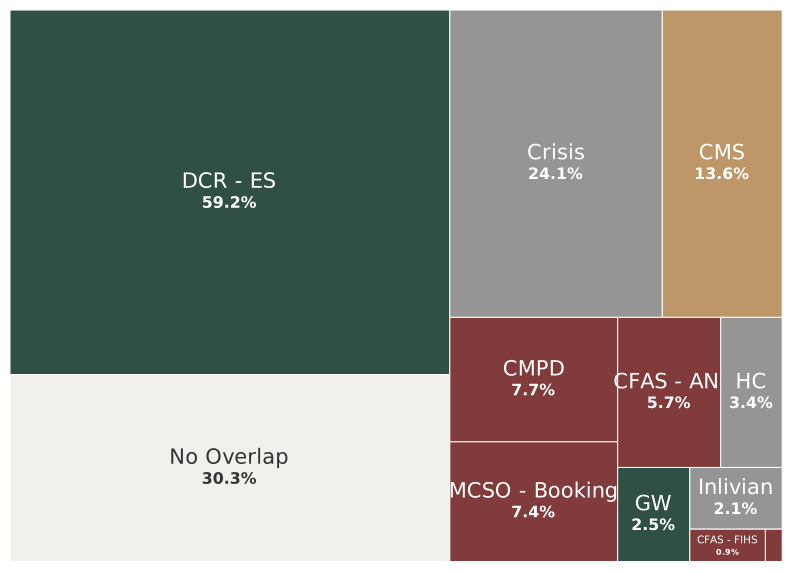
The figure above shows the percentage of people who used a housing or homelessness service through the Homeless Management Information System and who overlapped with other data partners in 2024. For example, 24% of people who used a housing or homelessness service through HMIS were also served by the Crisis Assistance Ministry and 7.7% were also reflected in the Homeless Management Information System. See the 2025 State of Our Data Report for more information.
The reports discussed above are from one partnership. Other key reports on homelessness and housing instability, like our work with The Relatives, Housing First Charlotte-Mecklenburg and the eviction series, have also made use of integrated data to better inform our community. The Charlotte Urban Institute has learned a lot over the past decade and there are many more questions to answer.
We invite your partnership to better understand housing stability and homelessness related issues in our region.