Data

Analysis of two recent studies offers insight into workforce development in Mecklenburg County
Two different studies of Mecklenburg County’s workforce development programs, sponsored by Goodwill Industries of the Southern Piedmont, were conducted in the past two years– one looking at adults ages 25 and older, the other looking at youth ages 14-24. Analysis of the two studies revealed many of the same problems and offered many of the […]

2010 ACS data provide a wealth of new information about the Charlotte region
After the initial windfall of data from the 2010 Census that was followed by media outlets all over the country, the next wave of Census data is upon us. In this new age of the American Community Survey, we now get considerable data more often than every 10 years. For researchers like me, who work […]
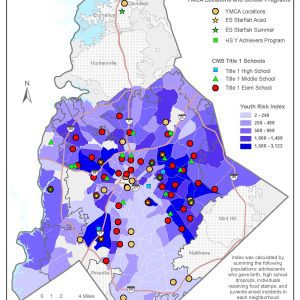
Youth Risk Index and YMCA and Title 1 School Locations
This map shows the locations of YMCA facilities and youth programs (Starfish Academy and the Y Achievers Program) as well as Title I schools, all in relation to the youth risk index of Charlotte neighborhoods. Starfish Academy is a YMCA program that serves pre-k through second grade students who are currently reading below grade level […]

Minding the gap – CMS’ focused efforts highlighted.
While recent recognition lauds the efforts of Charlotte-Mecklenburg Schools to address disparities among schools, the reality of the work still to be done is clearly visible in newly released maps of various school measurements. The maps, developed in a partnership between the UNC Charlotte Urban Institute and MecKEd, let users explore graduation rates, student proficiency, […]
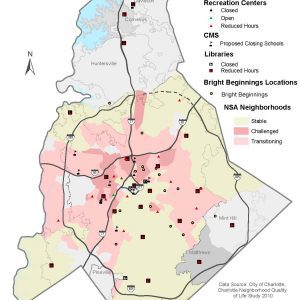
See the Bright Beginnings Map
This map shows the location of public recreation centers, libraries, and schools in relation to the quality of life status of Charlotte neighborhoods, with particular emphasis on facilities that have been closed or now have reduced hours. It was created by the UNC Charlotte Urban Institute, in collaboration with Council for Children’s Rights, to determine […]
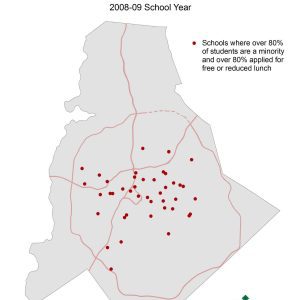
Maps of High-Poverty and High-Minority Schools
This series of maps shows the percent of students at each school in the Charlotte-Mecklenburg Schools (CMS) district that are a racial minority and the percent that applied for free/reduced lunch at two points in time, the 2001-02 and 2008-09 school years. The final two maps show only those schools in which the proportion of […]
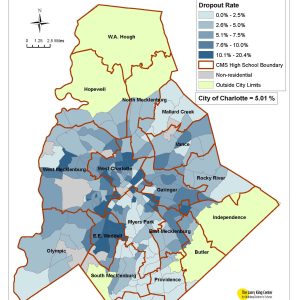
Dropout Rate for Neighborhoods and High School Attendance Zones
The UNC Charlotte Urban Institute created this series of maps, in collaboration with Council for Children’s Rights, in October, 2010, to provide background information and context for principals of Charlotte-Mecklenburg (CMS) high schools and the CMS Investment Group (a group of private donors and community leaders that pledged $55 million to improve graduation rates and […]

Snapshots of a resilient America
Amid the pervasive gloom and depression about the future of American cities I was lucky enough to visit recently two very different American places that hold out some hopes for a sustainable future here in the USA. On the face of it, Champaign-Urbana, Ill., and Boston, Mass., could not be more different: one a large […]
Comparing two workforce reports
A Comparison of Findings and Recommendations of Two Reports: “Preparing Our Youth for Work: A Community Assessment”, August 2010 UNC Charlotte Urban Institute and “Workforce Development Sector Analysis: Focusing on Workforce Development for Adults with Barriers to Employment in Charlotte-Mecklenburg”, August 2011 Carol Morris Consulting and The Lee Institute Two different studies in the past […]

Where everybody is above average
In Garrison Keillor’s mythical hometown of Lake Wobegon, all the children are above average. In terms of where the college-educated live, there are a few Lake Wobegons, and then there is everywhere else. In North Carolina, the state’s top two cities, with their higher concentrations of college-educated residents and their population heft, boost the state’s […]