Data

New reality: the rise of high-skilled immigrants
When you think of an immigrant, what comes to mind: the person who helped build your house, or the physician discussing your treatment plan? New research indicates that “there are just as many high-skilled as low-skilled working-age immigrants currently living in the United States, and the growth rate of more educated arrivals to the United […]

The highs and lows of high school graduation rates
Charlotte-Mecklenburg high schools have some of the region’s highest graduation rates. They also have some of the lowest. A look at recently released public high school graduation rates for North Carolina shows a wide disparity in Charlotte-Mecklenburg Schools. Yet CMS as a whole, compared to other systems in the region, has the lowest overall graduation […]

Gaston, onetime manufacturing heavyweight, now lags Union
Local perceptions may not have caught up with the new reality in the Charlotte region’s manufacturing economy. Even before the recession began in 2007, declines in the textile and furniture industries were changing the structure of local employment. As the downturn continued, counties that depended less on textile and furniture manufacturing lost fewer jobs. The […]

UNC Charlotte Urban Institute Announces Regional Indicators Website
The Institute established the Charlotte Regional Indicators Project in 2007 to provide a data resource to enhance our understanding of the challenges and opportunities facing the Charlotte region. This latest initiative of the Indicators Project moves beyond the old format of a printed report (which resulted in data becoming obsolete as soon as it was […]
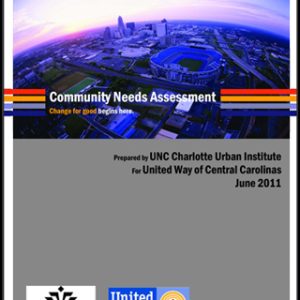
United Way of Central Carolinas Needs Assessment 2011 – Full Report
In June 2010, United Way of Central Carolinas commissioned the UNC Charlotte Urban Institute to conduct a comprehensive community needs assessment for its five-county service area. The primary purpose of the study was to pinpoint the community’s greatest needs and identify gaps in the current array of human services. This study is one of several […]

School Readiness Plan
The Larry King Center (LKC) of the Council for Children’s Rights recently released a plan for improving school readiness for the children in Mecklenburg County. “Unlocking the Potential of a Community: The Plan for School Readiness” is based on data, research, and input from six action teams comprised of community leaders, agency directors, and parents […]
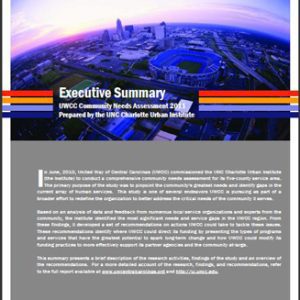
United Way of Central Carolinas Needs Assessment 2011 – Executive Summary
In June 2010, United Way of Central Carolinas commissioned the UNC Charlotte Urban Institute to conduct a comprehensive community needs assessment for its five-county service area. The primary purpose of the study was to pinpoint the community’s greatest needs and identify gaps in the current array of human services. This study is one of several […]

Charlotte region ages around a youthful core
In 1960, the median age for the United States was 29.5 years, meaning that half the population was older than that, and half was younger. In the 2010 Census, the median age for the country moved up to 37.2 years, reflecting what many demographers refer to as the “graying of America”. As with other changing […]
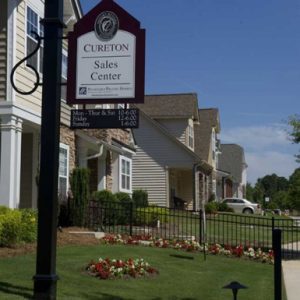
Census 2010: North Carolina is 6th-fastest growing in U.S.
An examination of the Census 2010 data released so far provides several insights into how North Carolina’s growth compared to other states. North Carolina was the 6th fastest-growing state in the 2000s at 18.5%, putting it just between Texas and Georgia, and virtually tied with Georgia in growth since the 1990s. That level of growth […]
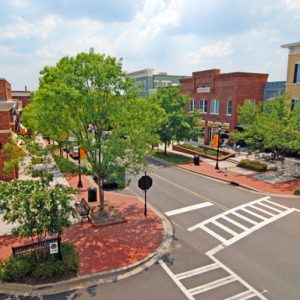
Census 2010: South Carolina Counties in the Charlotte Region
The recently released South Carolina data from US Census 2010 now allow for a more complete picture of growth in the Charlotte Region in the last decade. The South Carolina counties of Chester, Lancaster and York form the southern flank of the 14-county Charlotte Region. The census data show York County was the second-fastest growing […]