Alternatives to Violence in Beatties Ford: Year-three program evaluation reveals promise and opportunity
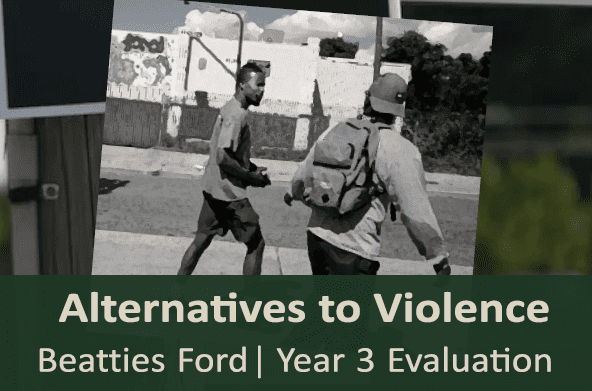
In 2019 and 2020, homicide rates within Charlotte rose by 45%.
This rise motivated the City of Charlotte to implement the Alternatives to Violence program within the Beatties Ford Road corridor. The corridor includes historical landmark neighborhoods and sites, Black-owned businesses and Johnson C. Smith University, Charlotte’s only historically Black college. While rich in community, history and culture, the corridor has borne the burden of historical discrimination and marginalization (e.g., redlining, predatory lending), resulting in a lack of socioeconomic development and resource investment– leading to disproportionately higher rates of poverty, crime and violence within the corridor.
This environment, along with a high-profile mass shooting that left four dead and multiple injured during a Juneteenth celebration in 2020, made the Beatties Ford community an ideal location for the implementation of the ATV program.
In 2024, the Charlotte Urban Institute partnered with the City of Charlotte and Youth Advocate Programs, also known as YAP®, to evaluate the ATV program. The ATV program utilizes the Cure Violence Global model, which aims to reduce violence by detecting and interrupting violence before it occurs, identifying and changing the behaviors of those at highest risk of violence, and mobilizing communities to change norms surrounding violence. In April 2022, the Institute was contracted by the City to evaluate the program’s effectiveness during the first (2022) and third year (2024) of the program’s implementation within the Beatties Ford corridor. [Read the full report here]
While the city currently has three ATV sites, this evaluation only reflects outcomes from the YAP® ATV Beatties Ford Road site.
The Institute’s evaluation team tested the potential impact of the ATV program by analyzing quantitative (information that can be measured, counted, and represented with numerical value) and qualitative (non-numerical information that reflects qualities and characteristics such as opinions and behaviors) data, including:
- Administrative data from ATV
- Crime data from the Charlotte-Mecklenburg Police Department
- Semi-structured interviews with ATV staff
- Community Survey
The study focused on outcomes during the first (2022) and third (2024) years of the program’s implementation.
Behavioral and social outcomes
ATV participation increased in year three, with the program adding 10+ new participants from year one to year three. Case notes provided by staff revealed that 242 referrals were made in year three, implying increased participant awareness of community resources. Case notes and documented success stories provided by staff also indicated that participants are receiving referrals catered to their specific needs and goals. Staff noted improved academic performance, employment opportunities and engagement in new experiences among program participants, such as attending sports events or city council meetings. Staff interviews also highlighted improved relationships within the community, explaining how trust was developed and nurtured through community programming and canvassing.
Community violence outcomes
To measure if the program achieved its intended effects of preventing violence within the corridor, the evaluation team analyzed aggravated assaults, robbery, sexual assault and homicides between 2019 and 2024. To isolate the impact of the ATV program, changes in crime rates in these neighborhoods were compared to crime data from a representative set of neighborhoods that did not have the ATV program. Results from the evaluation showed that crime rates in ATV neighborhoods began to decline by year three, with a statistically significant reduction in robberies, suggesting that the ATV program may have had a possible delayed effect within the area. Most other changes were not statistically significant and cannot be confidently attributed to the program.
Shifts in community norms and awareness
A community survey captured information on community members’ awareness of ATV, their engagement and knowledge with anti-violence work, their experiences with local violence, and community norms surrounding violence and prevention. By year three, community members reported less violence, weaker norms around guns, and improved perceptions of safety compared to year one.
Awareness and engagement with ATV and other anti-violence initiatives declined from year one to year three. Among those who were aware of ATV, more year three participants were unsure of the impacts of the program compared to year one, and significantly fewer knew someone who ATV had helped.
Recommendations
ATV staff provided recommendations to strengthen the program and increase visibility within the community.
- Establish a dedicated community resource center
Create a centralized, consistent, and secure location for services, support and workshops rather than relying on external venues.
- Enhance branding efforts to improve program visibility
Ideas include more street marketing, branding, and the use of shared program resources among staff.
- Launch a student ambassador program
Engage high school students in promoting conflict resolution and mediation, with recognition or rewards for contributions to reducing violence.
Recommendations from the Institute’s evaluation team to improve the ATV program included:
- Increase program awareness and outreach
Develop a program website with outreach contacts or a hotline, and distribute signs, flyers, and brochures in community spaces to address low awareness and engagement.
Why these results matter
Third-year results show that the ATV program has contributed to a reduction in community violence within Beatties Ford, and has established trust and support within the community.
Results show that participants have achieved improved behavioral mindsets while enrolled in the program. Although changes in crime rates, aside from the significant third-year reduction in robberies, cannot be directly linked to the ATV program itself, insights from survey responses, staff interviews, and case notes indicate promising results with shifts in norms, community safety, and participant behavior. Improving program visibility within the corridor will be essential for expanding and tracking the future impact of the program.