Annual Omnibus Survey
The Charlotte-Mecklenburg Annual Survey is a tool to help community organizations and stakeholders understand public opinion on a variety of issues that impact them and the region. The UNC Charlotte Urban Institute collaborates with community partners to identify and design survey questions of interest, then conducts a probability-based random sample survey of Charlotte- Mecklenburg residents.
For more than 30 years, the annual survey has helped gauge the pulse of our community in a reliable, data-driven manner. Topics have ranged from the environment to arts, culture and social trust, from the economy to personal values and reactions policies. We offer this collaborative tool to local governments, non-profit organizations and academic researchers as an affordable means to collect high-quality data and analyses of our city and county.
Our modular, collaborative design allows partners to access representative data at a fraction of the cost of multiple surveys conducted separately.
If you would like to participate in the next Annual Survey or have questions about the Institute’s other survey services, contact Kailas Venkitasubramanian.
What is included?
- Question development and refinement to ensure survey data is useful.
- A random-sample telephone (land line & cell phone) survey of 400 Charlotte-Mecklenburg residents.
- An analytical report that includes basic analyses and summary of the data generated from the survey.
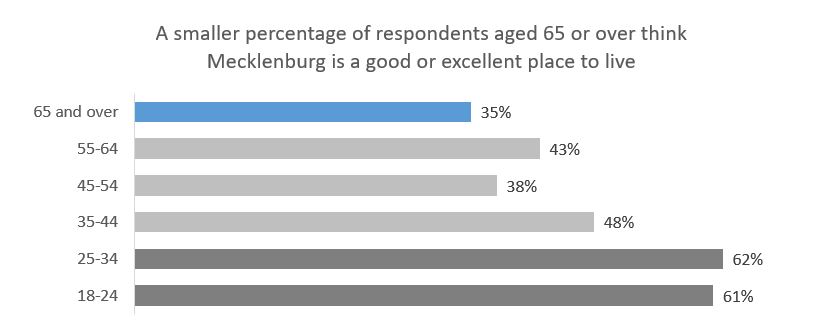
Results from a question on the 2017 Charlotte-Mecklenburg Annual Survey
How much does it cost?
Basic costs for partners are typically calculated per question, and vary annually based on vendor and service costs. The approximate price of the first question is $1,400, with subsequent questions priced between $1000-$1200.
Additional research services are also available, including more extensive reports, advanced statistical analyses, or preparation of data for organizational dashboards.
Who can partner?
Any organization interested in gaining insights about Charlotte and Mecklenburg County through a representative sample survey is welcome to collaborate We have typically served non-profit organizations, academic institutions and local government agencies. We welcome organizations and institutions both within and outside Charlotte to partner in the annual survey.
What’s the process?
- The Institute calls for partners for the annual survey through the website and email lists. (If you would like to be added into the list, please contact kvenkita@charlotte.edu). The call will provide more details about costs and timelines for response. You can inquire about the process at any time.
- The survey is designed in modules. Each module is set of survey questions dedicated to the needs of a partner/sponsor. Institute staff will contact interested sponsors to discuss specific data and analytic needs and prepare their modules. If partner modules have similar content, the Institute will work with the partners to possibly combine questions or otherwise maximize the utility of the survey.
- The survey typically measures a set of demographic characteristics. The Institute may add more questions based on partner requirements.
- The Institute conducts the survey and generates an analytical report for each module. The report includes basic summaries of the module, descriptive statistics of module questions along demographic dimensions.
- Partners may request more extensive analyses and reporting as an additional service.
FAQs
Who is eligible to partner in the survey?
Any organization interested in research or public opinion about the city of Charlotte and Mecklenburg County is welcome to partner in the survey. In the past, we have partnered with local/regional governments, non-profit community organizations, research groups and individual researchers.
How do you ensure that the survey is representative?
The annual survey is based on a probability-based random sample which ensures that the results are generalizable to Mecklenburg County residents. We also weight and process the data to correct for non-responses among key cross-sections of the population consistent with the best practices in survey research.
Does the Urban Institute conduct similar surveys in other cities and counties?
The annual survey program is currently limited to Mecklenburg County. But we’ll be happy to discuss conducting surveys in both our primary service region and other areas. Please contact the team.
How many questions can I contribute into the survey?
As many as you need to address your questions. But if you are planning to contribute more than 25 questions, please contact us to discuss if there might be a more cost-effective alternative.
I have research questions that require complex analyses or statistical modeling. Will the Urban Institute help?
Yes. The Institute is capable of providing analytical results with a wide array of statistical modeling frameworks and techniques.
I have some questions to ask but I can’t find the correct way to frame them. Can the Urban Institute help?
Yes. As part of the annual survey engagement, our researchers will help frame research questions and identify how they could be translated to valid measurements.
I’m conducting research on human subjects. Will the survey need institutional review board approval?
The Institute conducts the annual survey under a blanket exemption protocol given by the IRB of UNC Charlotte. Please contact us early to determine if IRB would be required to field your questions in the annual survey. The Institute will facilitate IRB applications as an additional service.
My study area is a smaller area within Charlotte. Is the annual survey right for me?
It depends. The annual survey is designed for the Mecklenburg County as a whole. If your study area is within Mecklenburg, please contact us to discuss if this would be feasible.
What are the costs?
Costs typically vary by the survey year and wave. Pricing is per question. Please look up the current annual survey page for this year’s pricing.
What are the deliverables of the annual survey?
The standard deliverable is a technical report that addresses your research questions and study objectives. This includes analytics of your key metrics and breakdowns by demographic groups of interest. (Please see ‘What’s included?’)
Deliverables can be customized. We can help you develop insights based on hypothesis testing, statistical models and customized data analyses.
What is the annual survey of Greater Charlotte?
The annual survey is an omnibus community survey of Charlotte and Mecklenburg County conducted by the Urban Institute. The survey is designed in a collaborative framework – the institute solicits research/survey questions from multiple partners, designs a single survey instrument, facilitates survey operations and deliver individual, customized analyses and reports to partners and the community.
The annual survey continues to be the definitive community resource for high-quality analytical insights affordable to a wide range of community partners in Charlotte and Mecklenburg County.
What is the sample size and design?
The sample size is 400, with a margin of error of approximately 5%. We typically design a simple random sampling design of Mecklenburg County for the annual survey, but also consider stratified designs based on the research questions addressed in a wave.
What is the study area of the annual survey?
We conduct the survey in the Greater Charlotte Region. We currently define Greater Charlotte as encompassing Mecklenburg County which includes the City of Charlotte and towns.
What is the timeline for the annual survey? When will I get results?
The timeline to develop and deliver the survey is set based on the demand and resources every year. Expect three to four months from the beginning of a partnership.
Past collaborators have included:
● Arts and Science Council
● The Blumenthal Foundation
● Catawba College Center for the Environment
● Catawba Lands Conservancy
● Catawba Regional Council of Governments
● Centralina Council of Governments
● Charlotte Chamber
● Charlotte Regional Partnership
● Council for Children’s Rights
● Foothills Conservancy of NC
● Foundation For The Carolinas
● Gaston Together
● Goodwill Industries – Southern Piedmont North & South Carolina
● Katawba Valley Land Trust
● John S. and James L. Knight Foundation
● The LandTrust of Central North Carolina
● Latin American Coalition
● The Lee Institute
● Levine Museum of the New South
● Meck Ed(Mecklenburg Citizens for Public Education)
● Nations Ford Land Trust
● United Way of Central Carolinas
● Women + Girls Research Alliance